Going Beyond Code
01 Apr 2026
Green building starts with strict code, but some BoCo architects and building professionals are taking high-performance futher
WORDS Emily O’Brien
In Boulder County, sustainability isn’t a niche—it’s the baseline. The county enforces some of the nation’s most rigorous energy-efficiency standards for new construction and major renovations. Yet even here, where the bar is already high, local architects and builders are pushing it higher still. They’re moving beyond compliance to design homes that are healthier, more resilient, and built to perform beautifully for decades.
Beyond Code
“Builders who focus on high-performance homes usually aren’t worried about code because they’re going way beyond it,” says Jessica Hunter, president of Colorado Green Building Guild, founded in Boulder to support sustainable building professionals statewide. “Instead of focusing on checklists, high-performance builds prioritize how the whole house works together and where you make smart trade-offs,” she says.
Licensed architect and founder of Rodwin Architecture and Skycastle Construction, Scott Rodwin, says, “There is an axiom in the green building world that ‘you get what you measure.’”
Licensed architect and founder of cgmodern architecture, Cherie Goff, echoes the sentiment. “Focusing on a well-insulated, tight building envelope without oversized mechanical systems can go a long way,” she says. By investing in insulation and air sealing, builders can downsize heating and cooling systems, reducing costs and utility bills.
“You can always upgrade finishes later,” Jessica says. “But improving the envelope after the fact is invasive and expensive.”
Scott adds, “The county’s green building codes are strict, especially for larger homes. It takes experienced professionals and sometimes extra investment to meet them, but the result is higher performance and quality.”
Jessica advocates for clear, flexible building codes that let builders, architects, and homeowners select the best approach.
“If you can prove a home meets the targets for energy efficiency or ventilation, that matters more than dictating exactly how it has to be built,” she explains.
According to Boulder County’s BuildSmart program, larger homes may be required to pursue additional energy certifications. Programs such as Passive House Institute US or the DOE Zero Energy Ready Home program emphasize performance verification, energy efficiency, and indoor air quality.
Designing for BoCo
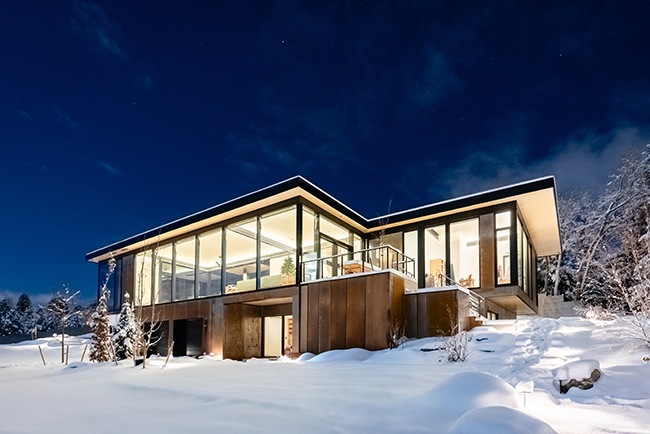
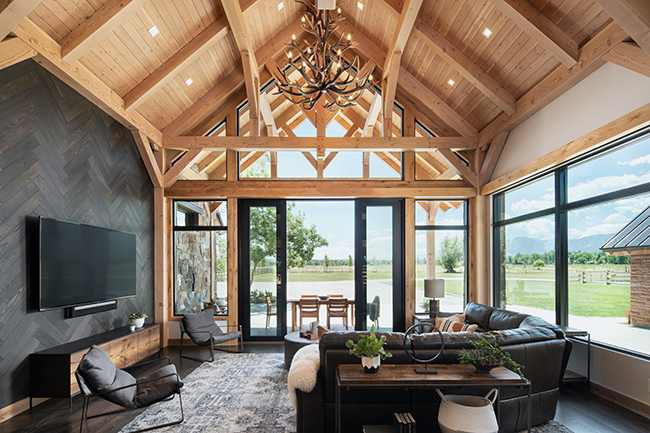
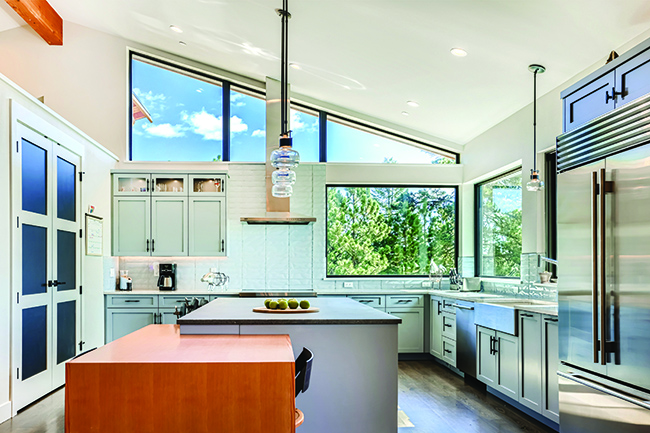
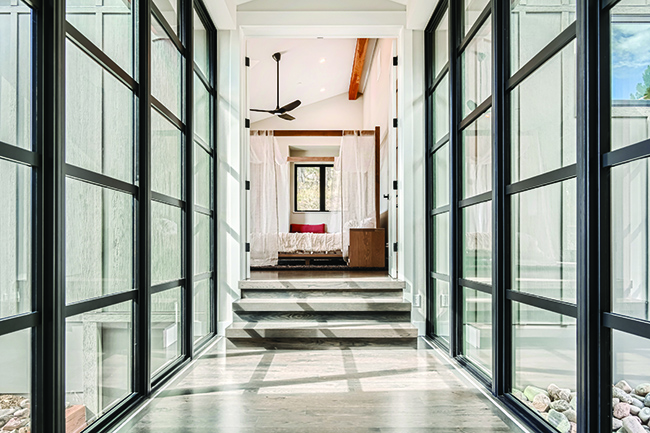
Cherie highlights the importance of window orientation in Boulder, where window placement and site choices—like shading and orientation—can noticeably improve energy efficiency and comfort.
“With thoughtful planning through glass selection, overhangs, and shading, you can control solar heat gain while still connecting to the site and capturing views,” she says.
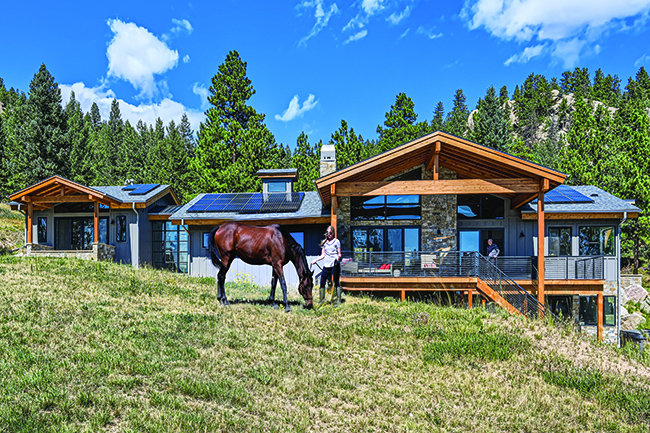
A tight shell also reduces smoke infiltration during wildfire season and stabilizes indoor temperatures during extreme weather swings. Electrification, envelope performance, water conservation, materials, and passive solar strategies all work together, says Scott.
The Trade-Off Equation
Sustainability decisions aren’t purely technical. They’re also personal. Jessica notes that homeowners often bring strong emotional associations to design choices. Fireplaces are a classic example. A traditional open wood-burning fireplace may feel nostalgic, but it can significantly compromise indoor air quality and energy performance.
“It’s a bit like asking your mechanic to bolt a coal engine onto your car,” she says. “A traditional fireplace can throw off the home’s energy performance and can seriously compromise indoor air quality. The county requires EPA-certified units, but go a step further and check out the all-electric vapor products available. You can get rid of that glass barrier and skip on the gas bill altogether.”
Cherie adds, “It’s balancing what the client wants with what performs well. Sometimes a better performing floor plan or more careful selection of products and materials can maintain the design vision while improving efficiency.”
Scott says budget allocation is often the toughest call. “Until the final bid is complete, some clients don’t know if they can afford ground source heat pumps, extra solar photovoltaics or batteries, and other top-end sustainability features. Our design-build process allows them to plan for future upgrades like pre-wiring for solar, even if the systems aren’t installed immediately.”
Cherie cautions that the term “net zero” can oversimplify sustainability. A home can achieve net zero with sufficient solar production even if the envelope and systems are not as good as they could be.
Jessica emphasizes reducing energy demand first and highlights dedicated fresh-air systems that filter incoming air, recover heat, and minimize exterior penetrations. “It’s hard to think of another single decision that accomplishes as much in one shot,” she says.
How do you know a high-performance home is working? Jessica measures it in three categories: energy, air, and lived experience. Builders conduct blower door tests to verify airtightness and confirm ventilation flow rates.
“Performance isn’t theoretical, it’s measurable,” Jessica says. “You see it in lower bills, better air, and a home that feels different the moment you walk in.”
Cherie says homeowner behavior also affects outcomes; real-world performance depends on both design quality and how the home is lived in.
Scott routinely asks clients to share utility bills one year after move-in. “Often, we’re able to help them learn how to operate their home better, and that usually improves performance. What we’ve learned from the data is that reducing energy consumption is about half the house and half how it’s lived in,” he says.
Learn more at cgbg.org, rodwinarch.com, and cgmodern.com.