Reactions Required
02 Aug 2026
Anna Tsouhlarakis creates narrative-challenging Native art that refuses to be overlooked
Aug/Sept 2026
Written By: Kastle Waserman
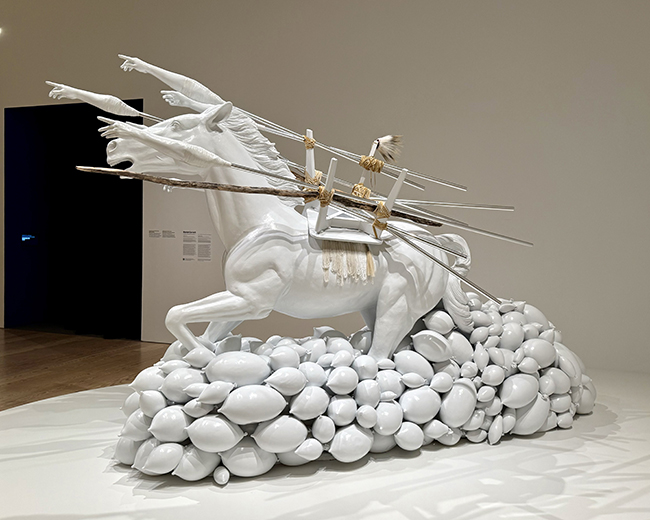
When you see Anna Tsouhlarakis’ sculpture “SHE MUST BE A MATRIARCH,” there’s a lot to take in. A white horse in motion, topped with a variety of items including human arms outstretched, spears at the ready, charging over a dust cloud of inflated condoms.
Every element is chosen with intention and meaning. The aspen wood used on the spears represents the interconnectedness of underground root systems. The condoms symbolize bodily choice, while menstrual cups placed next to a steer horn historically used for gunpowder make a statement for feminine power. A three-quarter-inch wrench signifies the artist’s three-quarters native blood. The arms were cast from Native American women, including her own. And then there’s an overturned chair.
“I was thinking, ‘Would there be a saddle?’” Anna says. “Then I thought about how people pull out a chair for a woman or give a woman ‘a seat at the table.’ It’s upturned. Because it’s like, I don’t need your chair. I got my horse!”
The work, created in 2023 for the Museum of Contemporary Art Denver, was so powerful it was selected for the 2026 Whitney Biennial, where it is prominently placed near the elevator entrance as one of the first works visitors encounter at the Whitney Museum of American Art in New York. Anna described earning that placement as a lifelong professional goal since she first learned about it 25 years ago.
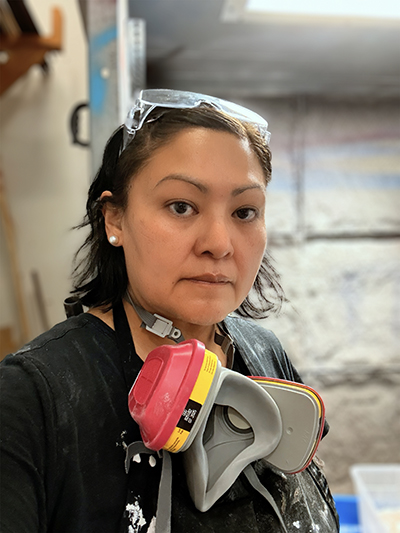
Her work spans sculpture, installation, video, performance, and public text-based works, and art is a way to explore her heritage as Greek and Native American, part Navajo and part Creek, often challenging preconceived notions of Native American art and identity.
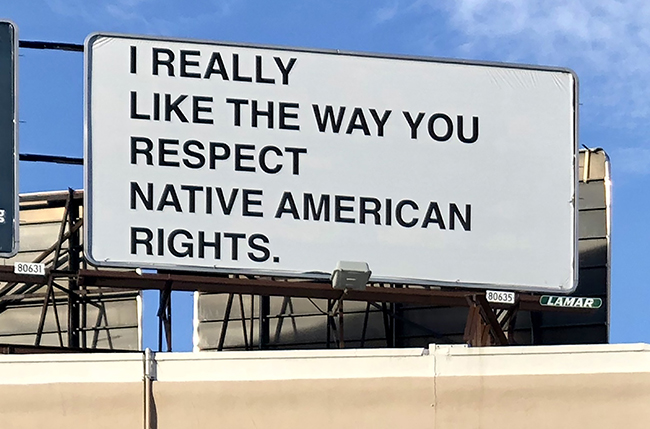
Her “Native Guide” project in 2019 consisted of large text billboards, banners, and social media with sarcastic phrases such as: “I really like the way you respect Native American rights.”
She says the pieces are intentionally designed as subtle yet provocative confrontations. She chose the billboard format because it bypasses the self-selection of gallery audiences, stepping into people’s spaces where they are.
“I realized that seeing the billboard could be a private moment where people were confronted with these ideas I’m putting forth. I really liked the idea of invading people’s minds with different concepts, then having them reckon with it on their own. They’ll either suppress it, or they might think, ‘oh my gosh, what is my reaction to this?’ and actually have a moment of self-reflection,” Anna says.
Her “Indigenous Absurdities” project in 2023, supported by a $50,000 Creative Capital Award, centered on Native humor—particularly the communal, teasing humor among Native women.
“I’m an urban Native. I didn’t grow up on the reservation. From a young age, I was the butt of the jokes in my family because I never rode a horse right or cooked right,” says Anna, who was born in Kansas and grew up in New Mexico. “I realized that was how my aunties connected with me and brought me in. I can see the way humor creates connection, so I really wanted to focus on that.”
The exhibit featured sculpture, including her “SHE MUST BE A MATRIARCH” piece, her text collages (seen for the first time in an interior space), and video. She says the titles were conceived first, and sculptures were then created as three-dimensional definitions of those titles.
She grew up as a self-proclaimed “math and science nerd,” but she’d always been around art through her father, who makes traditional Native American jewelry.
She moved to the East Coast to attend Dartmouth College, where she double majored in Native American Studies and Studio Art. In the early 2000s, when she pursued a Master of Fine Art in sculpture from Yale University, she noticed that installation, video, and performance work were prevalent in Asian American and African American art but not in Native art. She felt motivated to help change that. She says her math and science background directly informs her three-dimensional, spatial approach to sculpture and her use of calculations in casting and fabrication.
A position at CU Boulder brought Anna to Boulder, where she now serves as an associate professor and director of foundations in the art and art history department, overseeing introductory art courses. She says she loves being present at the beginning of students’ artistic journeys to help them find their artistic voice because it took a while for her to find her own. She says the job is a full-circle moment.
“It’s funny, when I was little, I was a big CU Buffs football fan and always thought I would go to school there, but then I didn’t,” she says. “Now, getting to be a Buff and a professor is a dream come true!”
For more information, visit naveeks.com