Built Together
02 Feb 2026
Three BoCo couples navigate the complicated, deeply personal work of running businesses—and lives—side by side
Story McKenzie Watson-Fore » Photos Chris Marley
Many people, when asked what they want in a relationship, will say they’re looking for a partner. In Boulder County, a handful of couples take that idea literally—sharing not only a life, but the daily risks, decisions, and responsibilities of running a business together. For them, partnership isn’t symbolic. It shows up in long hours, hard conversations, and a shared commitment to the communities they serve. Across fine art, food, and mobility, these three couples are building livelihoods shaped by trust, adaptability, and the unglamorous persistence required to make something last.
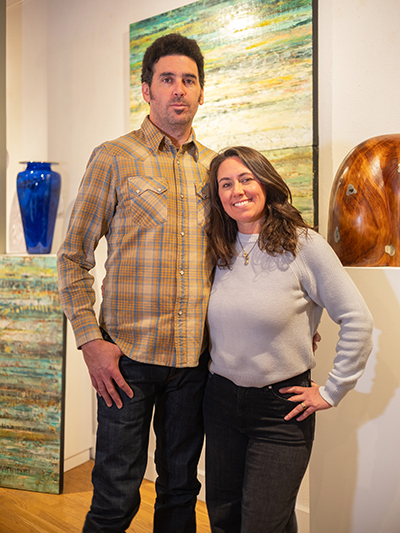
The story of SmithKlein Gallery is one of deep Boulder roots.
Nate and Ann Klein are second-generation owners who bought the gallery from its founder and Nate’s mother, Deborah SmithKlein, in 2014. She founded the gallery in 1984, and Nate grew up there, learning the art world through the artists and collectors around him.
If Nate’s been immersed in the art world forever, he’s known Ann for nearly as long. The two met at Boulder’s Columbine Elementary School when they were in third grade. “Debbie took us on our first date,” Ann jokes: a movie at the Village 4 Theatre (located where the Sprouts at 2525 Arapahoe is now), followed by a root beer float at Swensen’s, a nearby soda shoppe with a model train mounted near the ceiling. “We were good friends throughout childhood, high school, and college,” Nate says. “We started dating shortly after college.”
Nate briefly considered a different kind of life. “I was living in New York at the time, playing music,” he recalls. He considered going to Los Angeles for music but couldn’t quite figure out how to make it work. “The gallery kept calling him back,” Ann says.
Ann also worked in the gallery during college. “We were very established in the business when we decided to buy it,” she says. Their shared familiarity with the business has allowed them to continue Deborah SmithKlein’s original vision while also making it their own. Over time, the couple has scaled up the kind of artwork that the gallery shows. “The artwork is the wow factor of your house, the showstopper, the really unique artwork that defines a space,” Ann says.
Nate and Ann share a commitment to making the gallery a welcoming, hospitable place for anyone who comes in. “It’s all about creating a unique, positive experience,” Ann says. “We really try to break down the stereotypical barriers of an art gallery. You don’t need to be insanely wealthy to step in our doors.” Ann, Nate, and their two employees—also Boulder locals—seek to destigmatize the art gallery and to make world-class visual art accessible to the people of Boulder.
SmithKlein Gallery embodies the Boulder business scene: bespoke, distinctive, and intentional. “A lot of local business owners have made it for thirty, forty, or fifty years, and they’re all so important to downtown,” Nate says. “Our concern is that we’re seeing it continually become more expensive here, and that makes it harder for small businesses. Small businesses make downtown unique and special, and we hope to add to the allure on Pearl Street.”
From their long tenure with the gallery, the Kleins know the ups and downs of running a small business, especially one with a specialty clientele. “It can be hard to know what you’re going to depend on,” Nate says, “because fine art is not something that everyone is interested in and can collect. This is a really hard business.” But their wholehearted investment in the business also comes with upsides. “It’s our livelihood,” Nate acknowledges. “That gives us stronger connections with our clients, our artists, and our employees, Ari and Caroline, because we depend on this.”
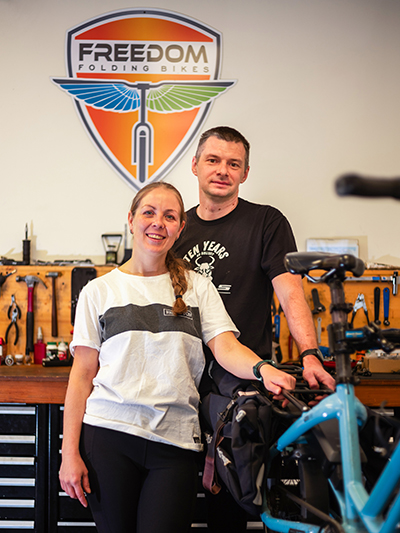
The story of Freedom Folding and Electric Bikes is one of meeting the challenge.
Hanna Boiarska and Ievgen Potykun share a background in business. Prior to owning Boulder’s Freedom Folding and Electric Bikes, they ran a successful furniture business in their home country of Ukraine. The couple met there more than six years ago. “I got pregnant in Ukraine,” Hanna says. “We had our first baby in Ukraine. We were planning our wedding in Ukraine. We bought an apartment four months before the war, and then the war happened.” In 2022, the couple came to Colorado as refugees and started over.
“It was a hard year and a half,” Ievgen recalls. “The hardest,” Hanna agrees. “It was scary.” Ievgen coached soccer and Hanna worked the night shift at Safeway, all while raising their now-three kids. The couple got to know Chuck and Laura Ankeny, the founders of Freedom Folding and Electric Bikes. “They’re like our adopted parents here,” Hanna says. The Ankenys had opened Freedom Folding and Electric Bikes in 2015 because they wanted to offer customers the flexibility and ease of a compact, portable e-bike, which are often dense, clunky, and inconvenient to store. By the time they met Hanna and Ievgen, the Ankenys had started contemplating retirement and a move to Arizona, but they didn’t know what to do with their beloved family business. When the Ankenys saw Ievgen and Hanna’s natural skill with customers and their willingness to learn, they knew they had found their successors.
“We said we could try it,” Ievgen says. “We could use our business experience, and we know how to make people happy.” Chuck became their tutor, teaching the couple everything he knew about bike sales and repair. They’ve learned so much Hanna notes that they can diagnose problems just by listening to the bikes in motion. Eighty-five percent of the bikes they service are bikes that customers have bought elsewhere. “We work on any kind of bike,” Ievgen says. “We work on the bikes no one else will work on, and we can make them work.” The couple is eager to help solve any problem they can. “I love to say, ‘Yes, we can do it,’” Hanna says.
Hanna and Ievgen have also diversified the range of products available at their store. Currently, Freedom Folding and Electric Bikes is the only vendor of recumbent tricycles in northern Colorado. “Recumbent trikes are the perfect vehicle for people who have problems with stability, people with a disability or certain health issues,” Hanna says. One of her favorite sales this past year was the sale of a recumbent trike to a ninety-three-year-old. “People his age are still looking for bikes!” Hanna says.
In every facet of the business, Hanna and Ievgen are looking to make their customers happy. “We moved to the U.S. and started everything from zero,” Hanna recalls, “and now we have our family, our kids, and our business. Some people say we did a good job.”
For these couples, partnership isn’t a metaphor—it’s the daily work of listening, adapting, and showing up for one another and their communities. Whether they’re keeping Pearl Street distinctive, baking bread that draws regulars across county lines, or fixing bikes no one else will touch, their businesses are extensions of their shared lives. The stakes are high, the work is hard, and the rewards are deeply personal. In a region defined by independence and innovation, these partnerships prove that building something lasting often starts with building it together.
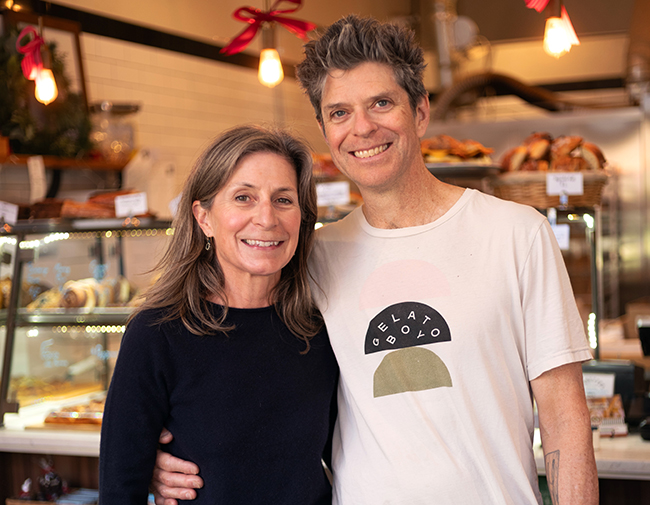
The story of Babettes is one of commitment to quality.
Steve and Catherine Scott opened Babettes Artisan Bread in September 2013 in the Source Market Hall in Denver’s RiNo neighborhood. Babettes quickly became known for its delicate pastries and large sourdough loaves. But the Scotts, who live in Longmont, had long envisioned bringing their business a little closer to home.
In 2019, Babettes moved to 2030 Ionosphere Street in Longmont’s Prospect Development. Catherine, who previously worked as an architect, knew the development’s owner. “We kept bringing him bags of pastries, saying, ‘we really think we should be here.’ Nobody thought a bakery would do well here, but the bakery did well from the first day that we opened seven years ago. We love being here,” Catherine says.
When the couple moved Babettes to Longmont, they expanded the concept to include a pizza restaurant in addition to a bakery. However, the restaurant side didn’t last. “Restaurants are hard,” Catherine says—and, about a year after Babettes’ relocation, the pandemic hit, reshaping the restaurant business in the image of to-go meals and quiet storefronts. The couple served takeout pizza during the shutdown and kept the bakery open daily. “It was a top priority for us to stay open for the community,” Steve recalls, “to be that warm comfort place.”
As business owners, the Scotts have always sought to reflect the desires of their customers. They’ve become adept at pivoting. The move to Longmont is one example; closing the pizza restaurant to focus on the bakery is another. “I think that’s one of the keys to being successful,” Steve says. “We see different waves in our customer base. We’ve gotten to a point where we can morph things to fit that new customer base. We really listen to them: what they want, what they’re purchasing at that time, and we’re flexible enough to make those changes.”
The Scotts have developed that flexibility by learning on the fly. “The first couple of years were a massive learning curve,” Steve says. “You can order, you can do the financials, pay bills, but when it’s your own, it’s a whole different ballgame.” Steve has stayed on the food side, always overseeing the quality of everything that is made at Babettes, and Catherine does the bookkeeping. “As a couple, we both have different ways of handling things,” Catherine says. “I think that’s why we’re a good team.”
The customer gratification is what keeps the Scotts going. Many of their customers are regulars, and some people still drive up from Denver to get their Babettes fix. For Steve, the inspiration has never ebbed. “How do we keep it relevant?” he asks. “How do we keep the quality high?”