Making Waves in Colorado
01 Jun 2026
Surfing the Centennial State’s standing waves
Written By: Chloe-Anne Swink
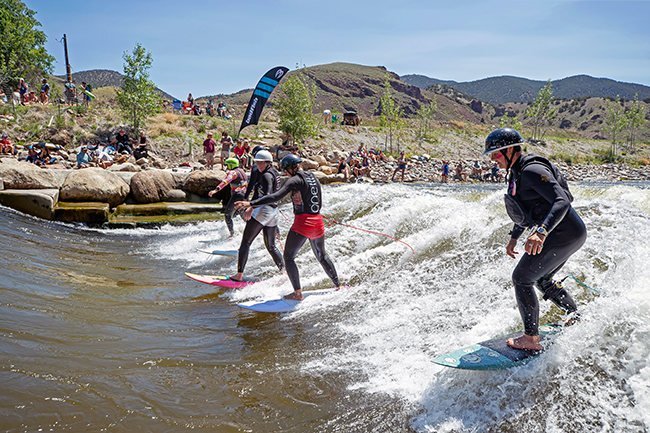
A new summer sport is finding its current in Colorado. From the Arkansas to the South Platte, as snowmelt swells the rivers, crowds gather along the banks, waiting their turn to ride standing waves that pulse through the current.
River surfing may feel like a recent phenomenon, but its roots stretch back to 1972, when surfers first rode standing waves on Germany’s Isar and Eisbach rivers. For decades, the sport remained the domain of early adopters and die-hard surfers chasing an inland fix. But a surfer’s going to surf—even a thousand miles from the nearest coastline.
What changed? Engineering.
The rise of whitewater parks in the mid-2000s transformed river surfing from a scrappy pursuit into a legitimate and increasingly accessible sport. Carefully designed standing waves now offer a consistent, surfable face—smoother, greener water, less guesswork and risk. Think of it as a surfing treadmill: As long as river flows are high enough, the wave holds. In Colorado, that means everything hinges on annual snowpack.
While natural hazards—rocks, debris, shifting currents—still exist, engineered waves significantly reduce the unpredictability. The result is a more approachable entry point that has opened the sport to a wider audience.
And with that accessibility comes something else: community.
At waves across the state, surfers of all ages line the banks, cheering each other on and trading turns in a rhythm that feels equal parts sport and social ritual. Parents and older kids ride the wave while younger siblings splash in the eddy nearby. It’s less solitary pursuit, more shared experience—part playground, part proving ground.
River surfing is still evolving—more Dogtown than X Games. Like snowboarding in the 1980s or skateboarding in its early days, it carries a sense of experimentation, a subculture still defining itself. The tools, techniques, and even the waves themselves continue to evolve as surfers push what’s possible on moving water.
Few have shaped that evolution more than Mike Harvey and Zack Hughes.
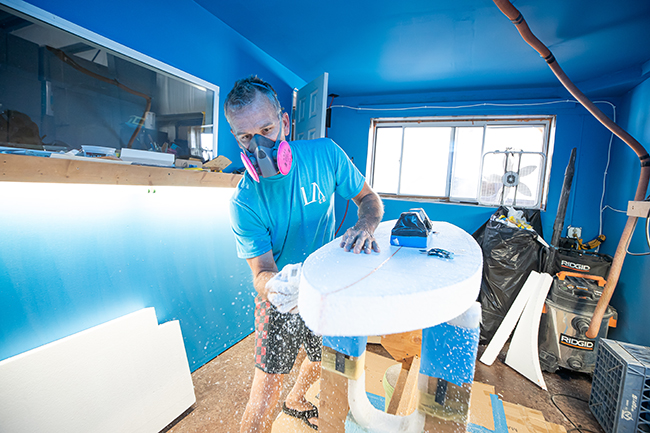
Mike, a project manager and designer with Recreation Engineering and Planning (REP), has helped build many of Colorado’s most popular whitewater park waves. Zack, a lifelong surfer who grew up riding ocean swells in California, brought that same dedication inland when he relocated to Colorado. Together, as cofounders of Salida’s Badfish Surf Shop, they’ve spent more than two decades refining both the waves and the boards designed to ride them.
Their work sits at the intersection of engineering and culture.
River waves have a way of creating community and drawing tourism to the towns they’re built in. Zack describes it as “a magnet for people to be around the river.” It’s easy to see why. A well-placed wave turns a stretch of river into a gathering place—a built-in spectacle where surfers rotate through while spectators linger, pulled in by the energy of the scene.
That visibility is intentional.
“These things are for the whole community,” Mike says. “It’s a very democratic process.”
Whitewater parks aren’t designed solely for surfers; they’re built as shared recreational spaces, with improved access points, calmer eddies, and areas for wading and play. Families can spend an afternoon along the river without ever stepping on a board.
Unlike other whitewater sports, which often require complex logistics and remote access, river surfing is refreshingly straightforward. It’s closer to showing up at a local climbing crag—gear in hand, community already there, action unfolding in one place.
Although there are mentions of a surfable wave at Eben G. Fine Park, according to Mike, it’s a bit of a white whale. The wave in question is naturally occurring and, if the flows are ever high enough to make it surfable, it’d only stay that way for a day or two and wouldn’t be beginner-friendly.
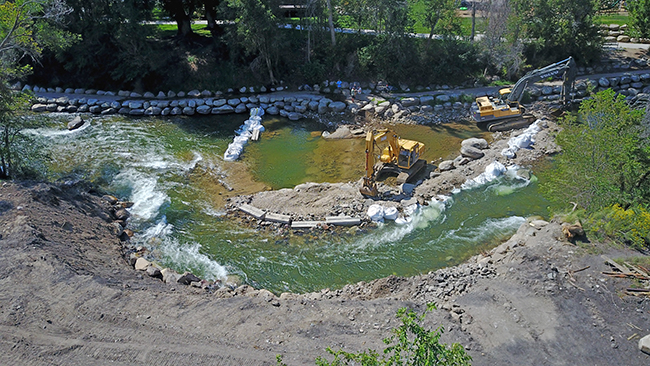
Clear Creek Whitewater Park in Golden is Boulder’s nearest wave. At this point in river surfing’s evolution, getting to the wave is still a “get in your vehicle and chase it around kind of deal,” as Zack says.
Still, not every stretch of river is suitable for a wave. “There are a lot of stakeholders anytime you’re doing anything in a river,” Mike explains. When scouting locations to develop new waves, whitewater engineers are on the lookout for areas with good pedestrian access, like parks, where they can add positive recreational opportunities for the broader community.
They also have to remain compliant with local, state, and federal permitting requirements, federal laws such as the Clean Water Act, and oversight from Colorado Parks and Wildlife throughout the process.
At their best, these projects offer more than recreation. Though not restoration efforts by definition, well-designed whitewater parks can improve river conditions and create a net positive ecological impact within heavily used waterways.
As the waves have improved, so too have the boards.
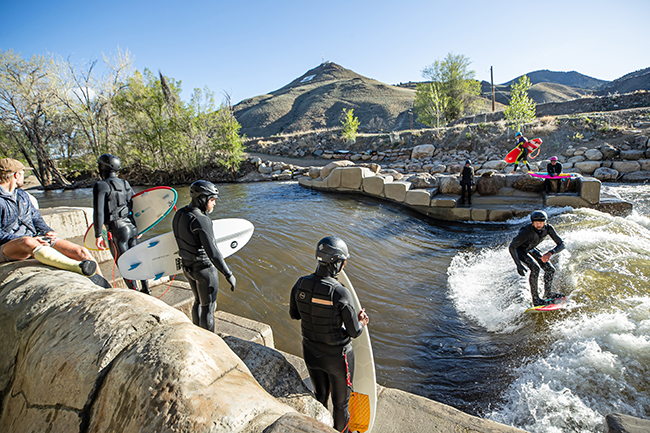
Early river surfboards borrowed heavily from kayak design—thicker, higher-volume shapes built for stability. Today’s boards are sleeker, more refined, and increasingly similar to their ocean counterparts. Zack has spent years iterating on every detail, from rocker profiles to bottom contours, fine-tuning performance for the unique demands of standing waves.
His secret weapon? Watching people surf.
Zack regularly spends hours by a wave, observing how different bodies move across the water—how weight, height, and stance affect performance—always looking for ways to refine board design.
One of his longest-running case studies has been Mike’s son, Miles. Zack watched him progress from a beginner to a highly skilled surfer, shaping custom boards along the way to support his development and further push his performance. Each iteration builds on the last.
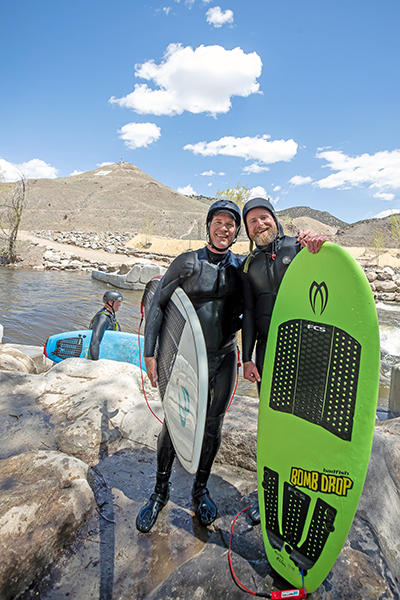
And that evolution shows no signs of slowing.
If the trajectory of other board sports is any indication, river surfing is poised for continued growth—more participants, more refined equipment, and higher levels of performance.
For those curious to try it, the entry point remains refreshingly simple: show up. Aside from Golden, Colorado’s best waves can be found in Montrose, Glenwood Springs, Buena Vista, Salida, and River Run Park near Denver. Bring a board. Chances are, someone will offer both guidance and encouragement.