A Story of Statehood
04 Aug 2026
Journey through the people and objects that shaped Colorado long before—and after—statehood
Aug/Sept 2026
Written By: Lexi Marshall
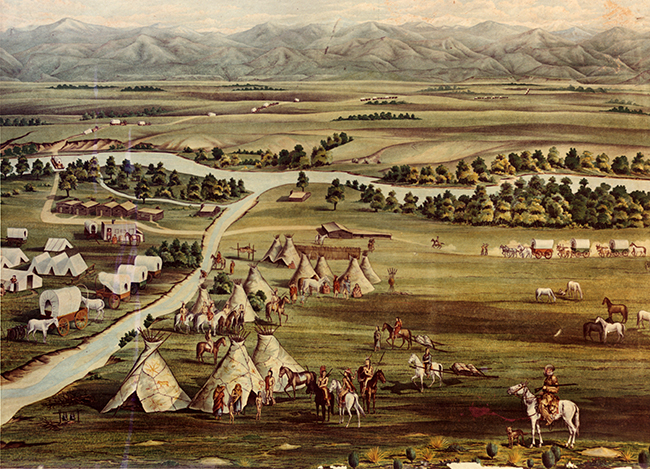
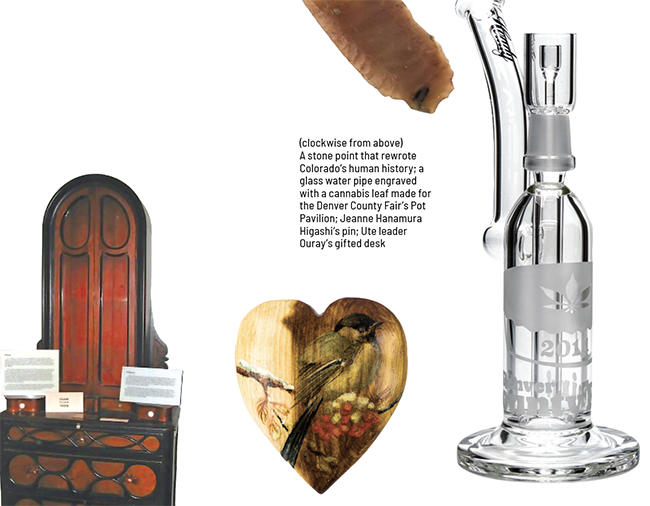
Before the proclamations and the gold rush, before the railroads and the ski lifts, there’s a spear point small enough to fit in your palm, chipped from rock somewhere between 12,900 and 11,700 years ago and unearthed at the Lindenmeier site outside Fort Collins. When archaeologists uncovered an artifact like it there in 1935, they transformed understanding of how long humans had lived in North America. People had been calling this place home for something like 13,000 years already. Colorado’s story starts well before anyone called it Colorado.
The number on the cake, 150, marks a legal moment, not a human one. On August 1, 1876, President Ulysses S. Grant signed a single handwritten page directing his Secretary of State to affix the national seal to a proclamation: Colorado was the 38th state, admitted just days after the nation’s own centennial. That’s where the nickname comes from, the Centennial State, though the land being celebrated had already been shaped by thousands of years of people living on it.
Those hands belonged, first and longest, to the Arapaho, the Ute, the Cheyenne, and others who saw this place less as territory to be claimed than as home to be tended. Among the Arapaho, the Clubbard Lodge Society performed elaborate ceremonies for protection and spiritual continuity, using ritual objects made of wood, paint, buckskin, eagle feathers, and eagle claw. When the Ute leader Ouray sat down to negotiate treaties with the U.S. government in the 1870s, federal authorities gave him an ornate desk, as if fine furniture could soften what was being asked of him. Ouray’s treaties largely kept the peace, though they cost his people much of their homeland.
The gold rush that set all of these events in motion arrived in 1858, bringing the strange machinery of a brand-new civilization assembling itself in a hurry. On April 23, 1859, a man named William Byers pulled the lever on an R. Hoe & Company printing press, set up between rival settlements Denver City and Auraria, and printed the first edition of the Rocky Mountain News. As towns sprang up and commerce followed, gold dust became the de facto currency of the mining camps. Private mints, and eventually the U.S. Branch Mint in Denver, transformed that dust into something more official. The only surviving gold ingot from the mint’s early operation is a modest 5.5-ounce bar made in 1865 by South Park miner Wilbur Fisk Stone from gold taken from his own placer claim. It is history small enough to fit in a coat pocket.
Into this contested landscape came wave after wave of people chasing something: opportunity, survival, a new beginning. Chin Lin Sou arrived in the 1860s to help build the transcontinental railroad. In 1880, a mob burned down Denver’s Chinatown and killed a man named Look Young. Two years later, the Chinese Exclusion Act shut the door on further immigration. Chin Lin Sou and his family stayed anyway. His daughter-in-law, Quon Tai “Daisy” Yuen Chin, wore an embroidered wedding dress in 1909 that announced, in silk and color, both the family’s prosperity and its refusal to disappear.
Florence Bell came by a different road. Born into slavery in Missouri, she headed west after the Civil War. Over three years, she stitched a quilt by hand from more than 300 spools of silk, finishing it in 1893. Its asymmetrical patterns and vivid motifs make it a standout piece even within the quilting tradition. Florence died in 1895. Her husband John brought the quilt to Colorado, and it went on to represent the state at the 1904 World’s Fair, work made by a woman once denied ownership of herself, now seen by the whole country.
The 20th century compressed Colorado’s contradictions into smaller and smaller objects. At Amache, the Japanese American internment camp near Granada, more than 7,000 people, most of them U.S. citizens, were imprisoned between 1942 and 1945. Some of them made art while they were there. Among what survives is a small handcrafted heart-shaped pin, kept by a girl named Jeanne Hanamura Higashi, who was 6 years old when she arrived at the camp with her family. Gaman, the Japanese word for enduring the unbearable with patience and dignity, describes both the pin and the girl who treasured it about equally well.
Not far away, in those same years, Colorado’s mountains were being turned into something else entirely. In 1944 and 1945, the 10th Mountain Division trained at Camp Hale near Leadville for alpine warfare, and their assault on Riva Ridge helped liberate Italy. When the veterans came home, many of them stayed, and many of them went to work on the very mountains that had trained them. Friedl Pfeifer ran the ski school at Aspen, which opened in 1946, with what was then the longest chairlift in the world and $3.75 for a daily ticket. Pete Seibert later founded Vail. An old chairlift chair from that first Aspen season sits today in a History Colorado collection, plain and utilitarian, carrying more weight than its size suggests.
The most recent objects in this story are also some of the most personal—and contested. A glass water pipe engraved with a cannabis leaf and the year 2014 was made for the Denver County Fair’s Pot Pavilion, billed, with some justification, as the world’s first fair exhibit dedicated to recreational cannabis. Colorado had voted to legalize recreational use in November 2012, the first state to do so. A civil union license issued in Lone Tree on December 7, 2013, belonging to Garth Criswell and Mark Kraft, two of the first couples to unite under Colorado’s newly passed Civil Unions Act, tells another story of changing laws and civil rights. Boulder County had briefly issued same-sex marriage licenses as far back as 1975. Getting from that moment to this one took decades, constitutional amendments, and a string of Supreme Court cases.
That’s the real arc of 150 years. Not a straight line toward some promised version of Colorado, but a record of who pushed, who resisted, and what got left behind along the way. The Folsom point. The quilt. The wedding dress. The pin. Imagine picking up any one of them and you can feel the weight of the whole state in your hand.
View these items and more at the History Colorado Center in Denver. For more information, visit historycolorado.org.