Colorado for All
02 Jun 2026
Governor Jared Polis on Boulder, identity, and building a legacy
Written By: Lexi Marshall
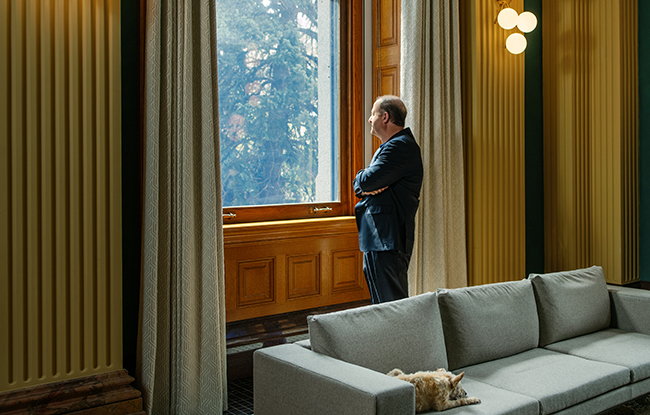
There is a particular symmetry to Jared Polis’ life that he does not let pass unnoticed. This year—as Colorado marks its 150th anniversary, the nation its 250th, and Boulder County the 51st anniversary of a quiet act of civic courage that changed American history—the man who serves as the country’s first openly gay governor was born a few blocks from where it all began.
“The same year that Boulder County’s clerk did the first same-sex marriages,” Polis says, “that was also the year I was born, just a few blocks from there at the old Boulder Community Hospital on Broadway.”
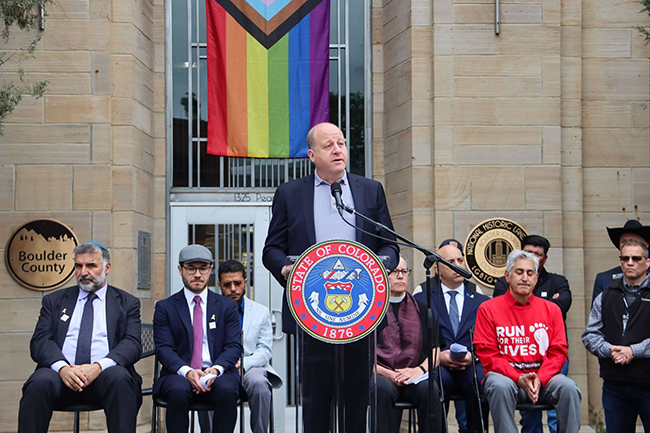
That clerk was Clela Rorex. In March 1975, just months into her tenure, Rorex issued the first same-sex marriage license in the United States—after determining that no Colorado law prohibited it. She ultimately issued six licenses before the state’s attorney general ordered her to stop. She faced a recall effort, hate mail, and threats, and resigned in 1977. She died in 2022 at 78. In December 2024, the courthouse where those licenses were issued was designated a National Historic Landmark.
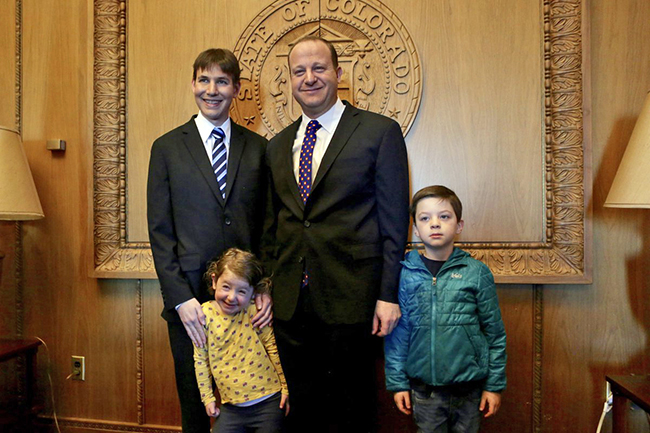
Polis was born into that same moment in history. He spent his early years just north of town before his family moved to San Diego when he was 5. But the area drew him back—for business, for family, and ultimately for public life. As the first governor since 1959 to not reside in the Governor’s Mansion, today, he’s back in Boulder with his husband, Marlon Reis, and their two children. In many ways, his story is inseparable from the place itself.
The Governor Next Door
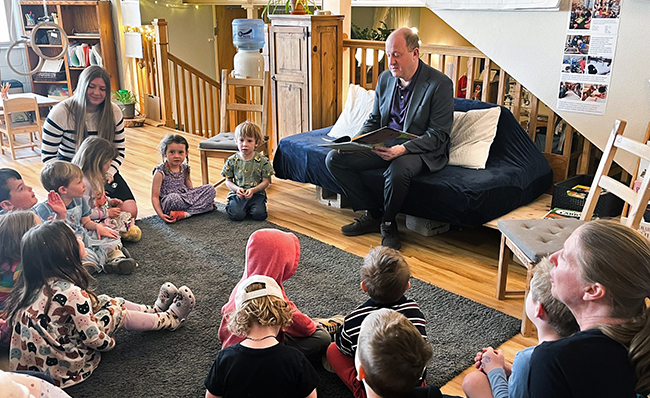
Ask Polis what he does with a rare free moment, and the answer is disarmingly ordinary.
“We love hikes with our kids,” he says. “Not crazy advanced hikes, just fun family hikes.” He mentions catching a show at the Dairy Arts Center and speaks easily about walkability, open space, and the wildlife that edges up against daily life—deer, bears, bobcats—with the familiarity of someone who actually spends time outdoors.
That grounding is intentional. Polis is now in his final year as governor. His second term ends on Jan. 12, 2027, and term limits mean he will not seek the office again. What comes next remains open. For now, he is focused on finishing the job.
That includes continuing to push housing affordability—particularly by removing barriers to building near transit—along with lowering income taxes, reducing property and car insurance costs, and strengthening protections for the state’s land and wildlife.
A Governor Who Governs
One of the more deliberate aspects of Polis’ public identity is how consistently he centers the work over the history-making nature of his election.
“I think people aren’t so much going to see me as the gay governor, but as the governor,” he says. “And hopefully the governor that delivers results—better roads, better schools, lower cost of living—and that’s important for Colorado’s LGBTQ+ population as well as for everybody else.”
That approach has defined his tenure. Since taking office in 2019, he has signed universal free preschool into law—saving families an estimated $239 million in its first year—and delivered free full-day kindergarten statewide. He has also advanced efforts to reduce health care costs and expand renewable energy, with the state now on track to reach 80 percent renewable energy by 2040.
His administration opened Fishers Peak State Park in 2020—one of Colorado’s largest at nearly 19,200 acres—and invested in wildlife coexistence programs, including bear-proof trash initiatives and public education campaigns. He points, with particular enthusiasm, to the return of river otters, once listed as endangered in the state and now reestablished across parts of the Western Slope.
“I said what I did and did what I said,” he says.
His governing style reflects a belief that pragmatism matters more than partisanship. “There are good ideas from the left and the right,” he says. “We need to focus on making Colorado more affordable, safer, and protecting our environment.”
An Origin Point
His connection to Boulder County is more than personal—it shapes how he sees community itself.
“It’s an amazing place,” he says. “For a county of its size, we really punch above our weight—arts, culture, startups, the university.” He describes the CU Boulder as a gateway to broader perspectives, and notes that many who arrive for school end up staying—drawn in, as he puts it with a laugh, by the pull of Chief Niwot’s curse.
He is equally direct about the challenges. Affordability remains the defining issue, particularly when it comes to who can remain part of a community they help sustain.
“Communities only function well when the people who work in them can afford to live in them,” he says. “Retail workers, teachers, law enforcement—people who are the backbone of our communities—need to be able to stay.”
He points to local progress on housing density as a step forward, tying it to broader goals around traffic, sustainability, and long-term accessibility.
What the History Means
When Polis was elected in 2018, he became the first openly gay man elected governor in the United States. He had already established a national profile: in 2008, he became the first openly gay non-incumbent elected to Congress, and in 2011, the first openly gay parent to serve there. During his time in Washington, he helped found the LGBTQ+ Equality Caucus and expand its reach.
“Governor Polis was willing to have any conversation—with conservative Republicans, progressive Democrats, leadership, or the White House,” says Roddy Flynn, former executive director of the caucus and now chief of staff to Rep. Sarah McBride. “He was relentless in that work. No issue was too small, and no conversation was off-limits if it could advance LGBTQ+ rights.”
Flynn points to the period following the Obergefell v. Hodges ruling as especially defining. “He helped guide the movement from a focus on marriage to a broader focus on nondiscrimination and full equality,” Flynn says. “By then, he had the credibility and influence to help shape that transition.”
In September 2021, Polis married Reis in a traditional Jewish ceremony in Boulder, becoming the first sitting U.S. governor married to a same-sex partner.
“His ties to this community run deep,” says Mardi Moore, chief executive officer of Rocky Mountain Equality. “When Clela Rorex knew she was dying, she had one last request: to congratulate Jared and Marlon on their marriage. And they came to see her in the hospital. As governor, he has signed more than 25 pro-LGBTQ+ pieces of legislation, making Colorado a safer place for people to live freely and authentically.”
Now, five decades after Rorex’s decision, that history feels less like a distant milestone and more like a throughline—one that connects a single act of local courage to the state’s highest office.
Polis acknowledges it without overstating it.
“It started at the Boulder County Courthouse with Clela Rorex,” he says. “And this community has its place in history.”
Colorado for All
If there is a phrase that captures his broader ambition, it is one he returns to often: Colorado for all.
“We want to build a Colorado for everyone,” he says, “whether you’re gay or straight, religious or not, whether you love the outdoors or not. Wherever you live, Colorado’s a place for you.”
That ethos—deliberately inclusive, notably nonpartisan—has shaped his time in office, even as the national political climate has grown more polarized. He frames the state not as an outlier, but as an example of what can happen when leadership stays focused on outcomes.
When asked how he hopes his tenure is remembered, his answer is direct: “That we reduced health care costs. That we moved toward one hundred percent renewable energy. That we got universal free preschool and kindergarten done. And that there’s still more work to do.”
It’s the answer of a governor still looking ahead, while rooted in a place that, long before he was born, helped shape the history he now carries forward.