Growing Resilience
02 Oct 2026
A living experiment in how land, business, and community can sustain one another
Oct/Nov 2026
Written By: Heather Shoning
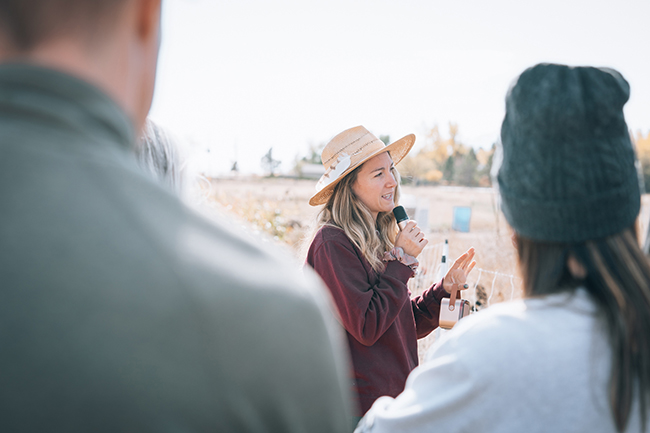
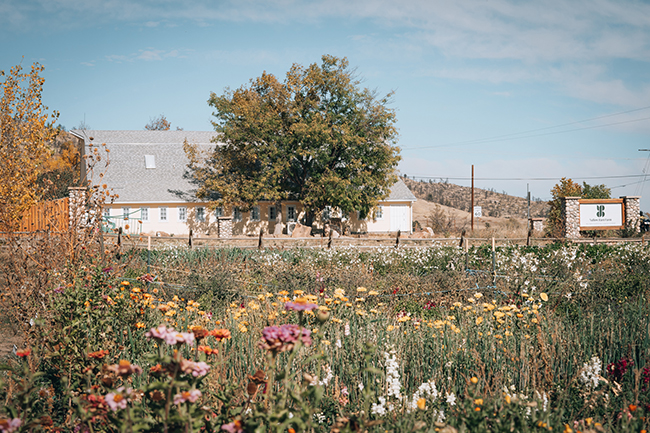
Azuraye Wycoff remembers an almost idyllic childhood on the 100 acres her family purchased in 2001, when what is now Yellow Barn Farm was still an equestrian center tucked against the foothills. There were horses, animals, open land, and the kind of freedom that comes with growing up in a place large enough to disappear into for an afternoon. “It was really magical,” she says. What she understood less clearly then was how difficult it was for her parents to sustain that magic. Agricultural land carried its own relentless economics—hay prices, property taxes, insurance, maintenance, and the steady demands of aging infrastructure—and over time, keeping the property afloat became increasingly difficult.
For nearly seven years, her parents tried to sell. The problem was not finding buyers; it was finding buyers who valued the land for what it was. Many saw 100 acres near Boulder and imagined development potential—condominiums, luxury homes, a profitable transformation from agricultural land into real estate. Her parents resisted. Then, in 2018, Azuraye’s father died, bringing her back to Colorado and eventually forcing a question the family had been circling for years: If traditional agriculture could not reliably support the property, what kind of economic structure could?
That question has become the organizing principle behind Yellow Barn. Over the past several years, Azuraye has been quietly constructing a model that challenges the assumption that preserving agricultural land requires relying almost exclusively on agricultural revenue. Instead, she has begun treating the farm as a complex ecosystem—one in which farming remains central, but is supported by an interconnected network of small businesses, service providers, wellness offerings, food producers, and community programming. The result is difficult to categorize neatly, which may be exactly why it is interesting. Yellow Barn is still a farm, but it is also a business incubator, a gathering place, a regenerative agriculture project, and, increasingly, a testing ground for a different way of thinking about rural economic resilience.
Azuraye’s instinct to approach the problem this way was shaped in part by her experience outside agriculture. In Boston, she built and ran a moving company, which taught her about cash flow, labor, logistics, and the less romantic mechanics of keeping a business alive. When she returned to Colorado, she quickly understood that the farm could not survive on idealism alone. “I was really trying to think outside the box of how do we make this whole thing work without having to sell our soul,” she says. The answer was not to abandon agriculture, but to reduce the pressure on agriculture to pay for everything.
That distinction is essential. “I don’t know that we could do this any other way without almost inherently having to extract from the land and the soil in order to make enough of an economic return,” Azuraye says. “The land really spoke to us and said, ‘That’s not what we’re here to do. We are here to take care of the land. We’re here to be stewards.’” At Yellow Barn, the land is being managed with the opposite objective. Drylands Agroecology Research, one of the farm’s foundational partners, has helped develop a regenerative master plan that includes rotational grazing, perennial plantings, water management, soil restoration, and roughly 10,000 trees planted through swale systems across the property. Those practices may build long-term ecological health, but they do not necessarily produce the kind of immediate, predictable revenue needed to cover the very real expenses of maintaining 100 acres.
Azuraye began to see a parallel between ecological biodiversity and economic diversity. A resilient landscape does not depend on a single species; why should a resilient farm depend on a single source of income? She often explains the idea through the metaphor of mycelium—the fungal networks beneath the soil that connect organisms, redistribute nutrients, and strengthen the system as a whole. “That doesn’t just apply to planting certain kinds of crops together,” she says. “It applies to an entire ecosystem of functions.” In her view, the same principle extends to people and businesses. “You need small businesses that might be operating here. You need different kinds of perspectives and skill sets. You need everything coming together because then you actually have mycelium.”
The businesses at Yellow Barn are therefore not intended to function as a random collection of tenants paying rent. Ideally, each occupies a useful place in the larger system. A spirulina grower, for example, moved into a greenhouse Yellow Barn had built but lacked the resources to operate. After repairing damage to the structure, he gained a working production space and the farm gained rental income, while the nutrient-rich water generated by the spirulina operation can feed into the farm’s compost system. Landscaping businesses bring organic debris that can become compost material rather than waste. A steam-weeding and compost-tea operation can use the farm as a base while returning excess compost tea to the landscape. Other businesses contribute labor, infrastructure, expertise, or materials that would otherwise have to be purchased or sourced elsewhere.
This circularity is not incidental to Azuraye’s thinking; it is the model. What one business discards may become another operation’s input. What one tenant knows how to build, restore, grow, or manage becomes part of the farm’s larger pool of capacity. Rent creates a more stable revenue baseline, but the more ambitious goal is interdependence rather than simple occupancy. “Compost is actually the biggest piece of all of this,” Azuraye says. While she is speaking literally, compost also serves as useful shorthand for the philosophy: value is created by keeping resources in motion rather than letting them leave the system as waste.
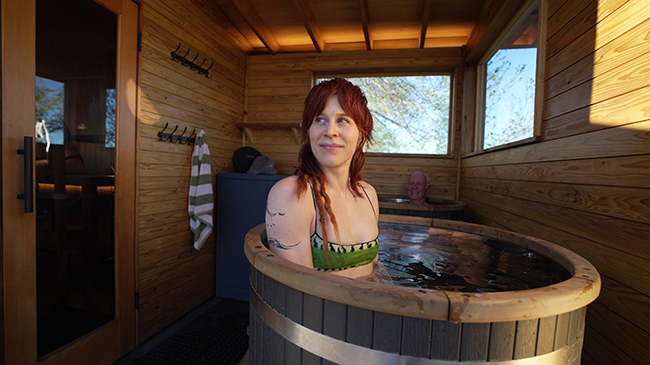
Puffin Sauna Club may be the clearest example of how far that thinking can extend. A wood-fired sauna tucked into a mulberry grove does not resemble a conventional agricultural enterprise, but Mitch Stubbs sees no contradiction in placing wellness tourism alongside regenerative farming. Puffin draws people onto the land for sauna sessions, cold plunges, gatherings, and wellness programming, creating another source of activity and revenue while introducing visitors to Yellow Barn’s broader work. “I strongly believe that sauna is part of an ecotourism business model, and it’s part of a regenerative agriculture business model in Boulder,” Mitch says.
The connection becomes more persuasive when examined at the systems level. Puffin burns locally sourced wood from diseased or dying trees, and its ash can be returned to Yellow Barn’s compost system. Mitch has also considered ways to capture excess heat from the sauna and redirect it toward greenhouse production. More broadly, Puffin gives people a reason to develop a relationship with the property itself. “A sauna is an important part of wellness, and wellness is an important part of connecting to land,” he says. “Having people see and witness and be with healthy land is an important part of human health.”
At Yellow Barn’s Wellness Wednesdays, those connections become even more visible: Visitors might pick up locally raised meat and vegetables, bring food scraps that can be redirected into the farm system, eat a meal, attend a wellness offering, listen to music, and finish the evening in the sauna.
What sounds, at first glance, like an eclectic collection of activities becomes more coherent when viewed through Azuraye’s mycelial framework. The objective is not to make every enterprise agricultural. It is to ask whether each enterprise contributes to the health, usefulness, or economic durability of the whole. That premise has required Yellow Barn to operate in spaces that conventional land-use categories do not always accommodate comfortably. Agricultural zoning was built around more traditional definitions of what happens on a farm; business incubation, wellness programming, events, and service-based enterprises do not always fit neatly within them. “It’s really easy just to say, ‘Well, that’s just how it’s always been done,’” she says. “I don’t think that there is one right answer any longer.”
Azuraye is candid about the tension. “If I really had to go the route of just making it financially and coloring within all the lines of what we’re allowed to do, this place would have gone under within year one,” she says. The irony is difficult to miss: regulations designed, at least in part, to protect agricultural land can become restrictive when the economic model required to preserve that land no longer resembles traditional farming. Azuraye is not arguing that rural property should become an unrestricted venue for commercial development. She is arguing for enough flexibility to allow agricultural properties to evolve before financial pressure leaves owners with only the most profitable option—which, in places like Boulder County, can easily be development.
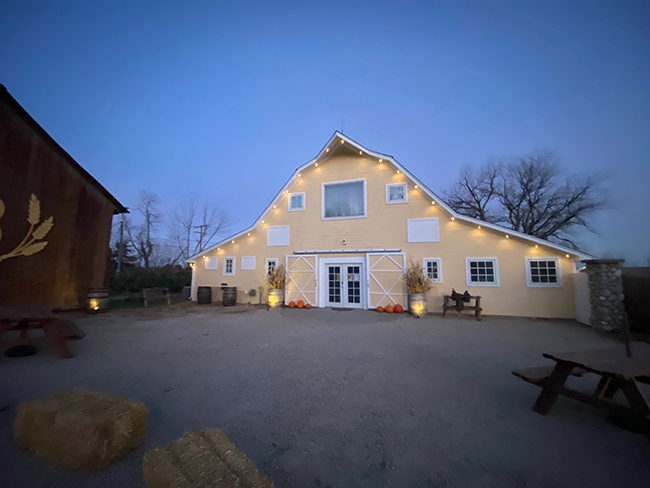
That is where Yellow Barn begins to matter beyond its own acreage. Azuraye increasingly hears from farmers and landowners wrestling with the same problem: How do you preserve land when the revenue traditionally associated with it is insufficient to sustain it? Her answer is emphatically not that every farm should install a sauna, grow spirulina, or host wellness events. “The goal is not to just be one Yellow Barn, and it’s not to be a ton of Yellow Barns,” Azuraye says. “It’s to take the pattern of what this is and to be able to put that on other farm-based, land-based locations at different size scales.” A farm in another region might support food processing, lodging, woodworking, education, grazing, makers, or businesses not yet imagined. The common principle is diversification built around the assets, needs, and ecological limits of a particular place.
She envisions that pattern extending eventually into a broader network of land-based hubs, with farms exchanging not only products but resources. Food scraps could move to livestock producers; produce could move back toward population centers; equipment, knowledge, labor, and distribution could circulate more regionally. The goal is not simply to make individual farms profitable, but to create what she describes as a nodal system—smaller, interconnected economies less dependent on long, fragile supply chains.
That ambition can sound grand when discussed from the vantage point of one 100-acre farm, but Azuraye’s thinking remains rooted in an intensely personal reason for trying. Yellow Barn is the place her parents fought to preserve, the place where she grew up, and the land she inherited responsibility for after her father’s death. She has watched how easily agricultural property can become something else once the economics stop working. For her, the experiment is not theoretical.
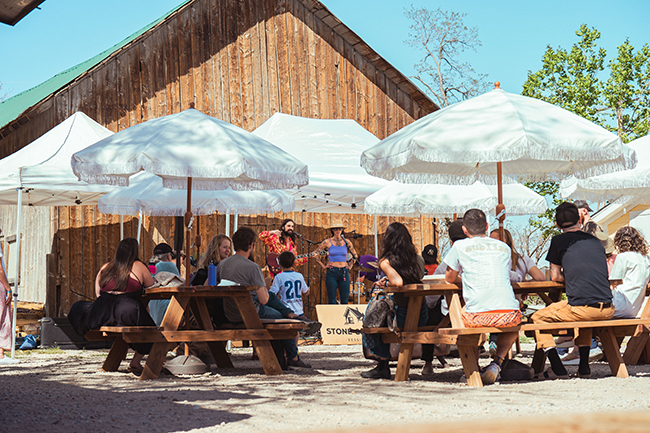
It is also not finished. Yellow Barn is only beginning to refine the systems that connect its businesses, improve communication among tenants, and determine which enterprises genuinely strengthen the larger ecosystem. Azuraye talks openly about years spent repairing infrastructure, improvising contracts, resolving conflicts, and figuring out problems for which there was no obvious model to borrow. The farm is moving out of its scrappiest stage now, but that evolution may be part of what gives the project relevance elsewhere. It was not built from a polished master plan or a large outside investment; much of it has been assembled through necessity, iteration, and the willingness to reconsider what a farm is allowed to be.
Azuraye hopes, eventually, that Yellow Barn can offer other landowners not a blueprint in the strict sense, but a sketch—a way of seeing possibilities that may already exist within their own properties and communities. “As with the idea of growing your own food—you want to grow your own economy,” she says. “We have bootstrapped everything. We did not take any donations. We have not taken any grants. We have figured out how to fund the whole thing literally by growing the economy that we have here.” The idea captures both the agricultural and entrepreneurial logic of the place: keep value circulating locally, build relationships that make each participant stronger, and let the ecosystem become more resilient because no single element is asked to carry the entire burden.
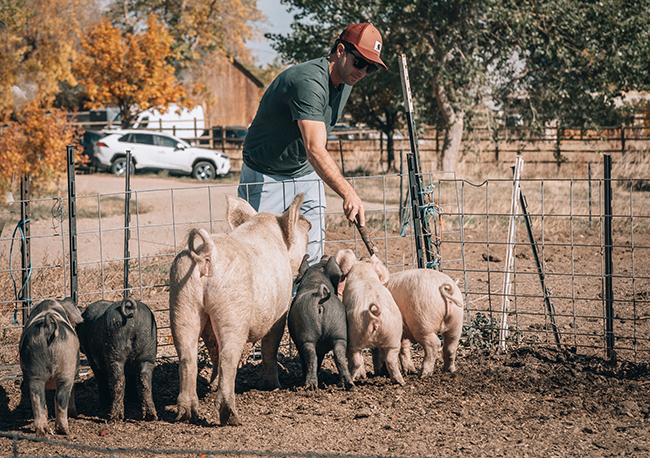
For all the complexity of that vision, Azuraye’s description of what she wants Yellow Barn to become is strikingly human. She imagines a place where someone can buy vegetables, pick up locally raised meat, sit by the land, visit the sauna, encounter a pig, or simply find enough quiet to write a poem. “This is a place for humanity,” she says. “It’s not meant just to be a farm. It’s not just a business incubator. It’s not just an event space. It’s all of those things combined, integrated, and deeply supportive of each other.”
The magic Azuraye remembers from childhood has not disappeared. What has changed is her understanding of what it takes to preserve it—and her willingness to question nearly every assumption about how that preservation is supposed to work.