Solar Energized
01 Apr 2026
The technology, incentives, and energy shifts driving solar’s next chapter
WORDS Karen Marley
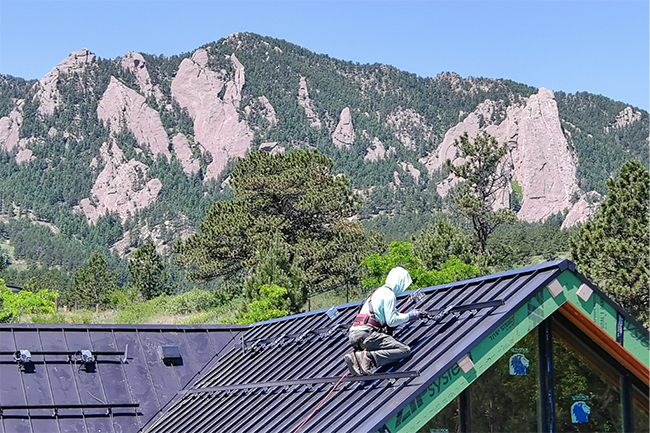
Colorado basks in sunshine. Beams pour over snowcapped peaks, creating those ephemeral alpenglow moments. Rays are also hitting residential solar panels, where they are converted into energy powering our daily lives. While bluebird days are emblematic of Colorado’s identity, the standing of solar in the Centennial State is less clear. It’s time to shine some light on solar energy and its future in Boulder County.
Indeed, the financial case for solar has become significantly stronger. Noah Herreid, director of commercial and special projects at Independent Power, an engineering, procurement, and construction solar company, points out that costs have dropped by more than 60 percent since 2010, thanks to improvements in manufacturing, supply chains, and installation methods. He notes that panels are also remarkably low-maintenance and even help protect roofs from extreme weather.
“This has helped solar move from a niche technology to a mainstream home upgrade across the Front Range,” Noah says.
Technology Amps Up
The photovoltaic effect, in which a material exposed to sunlight produces an electric current, was first observed in 1839. Since then, innovations and experimentation have continued to advance the technology, achieving new milestones in efficiency and productivity. Those developments are accelerating. In 2015, the average residential solar module efficiency was at 15.6 percent, according to the U.S. Department of Energy (efficiency percentage is the portion of sunlight energy converted by the photovoltaic cells). Today, efficiency rates hover around 22 percent. Simultaneously, panel wattage has also increased. Anna Perry, director of residential sales for Namaste Solar, explains that what was once a 200-watt solar panel is now a 435-watt panel. “You will spend less money installing your solar system, but get more power out of it,” she explains.

Home Electrification Powers Up
It works like this: Homes with solar panels are net-metered, a system in which the utility provider tracks the difference between the energy produced by your panels and the energy your home consumes. Homeowners are credited for excess production sent back to the grid. These credits cover additional energy use beyond what your panels generate at other times. Without a battery, consumption occurs in real time; energy cannot be stored for future use.
Conversations about advancements in solar must include batteries. Residential solar with a battery system also uses net metering, except surplus energy goes to the grid only after the battery is fully charged. Longer lasting and more durable in fluctuating temperatures, home batteries paired with solar are figuratively and literally powering a significant shift in energy resilience, security, and independence.
Batteries supply a home with uninterrupted electricity during outages. As more high-wind events force utilities to curtail electric distribution for safety concerns (e.g., wildfire prevention), a home battery paired with solar becomes quite valuable. But it gets even more interesting.
“Peak load demands have always been troublesome for utility operators,” says Ron Flax, chief building official for Boulder County Community Planning & Permitting. Historically, utility providers built power plants that operated only during peak demand to prevent overloading the grid. Pairing residential solar with batteries offers a cleaner, cheaper, and more efficient solution through a virtual power plant (VPP).
A VPP is a network of decentralized, small-scale power-generating units and storage systems that bolsters grid reliability. “It reduces long-term costs to the utility for grid infrastructure upgrades, which then trickles down to homeowners and should, if the system’s working correctly, mean slower increases in utility rates,” Anna says.
Charging Forward: Regulations and Incentives
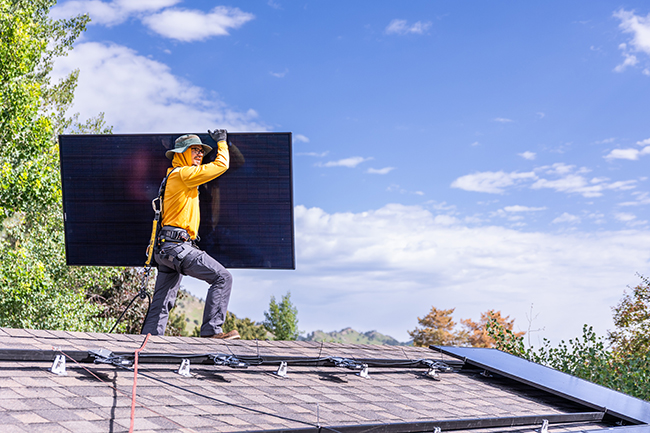
VPPs increase energy resilience, reduce infrastructure costs, and support decarbonization. The solar solution is gaining traction. In Boulder County, regulatory hurdles to installing solar are minimal, and Colorado passed legislation banning HOAs from denying rooftop installations. The City of Boulder is forthright in its efforts, requiring panels on all new residential construction greater than 1,000 square feet. Smaller projects must be solar-ready. The city offers a solar tax rebate grant.
Financial incentives for solar have shifted. Originally scheduled to run through 2034, the federal government pulled the plug on the Inflation Reduction Act’s 30-percent tax credit for residential solar last December. Recognizing the massive monetary and infrastructure benefits of solar and batteries, utilities are enticing Front Range homeowners with generous rebate and incentive programs.
Xcel Energy is just one example. Its Renewable Battery Connect Program offers homeowners $500 per kW of storage capacity up to 50 percent of the total battery cost ($800 per kW of storage up to 75 percent of the cost for income-eligible households), plus $100 each year. In exchange, Xcel can pull up to 60 percent of your battery power up to 60 times each year to supplement its grid.
Investing in solar also helps a home avoid rising energy rates. Owner of Flatiron Solar, Bob Monet, cuts to the bottom line. “Solar is dollars every day for thirty to forty years,” he says. Bob, Ron, and Anna report that they are working on financing programs to help homeowners.
“We’re seeing more people want solar,” Ron says. “More and more are opting for all-electric. That’s the other piece that is really interesting. All electric houses are becoming more common than ever before.”