Styled for Summer
01 Jun 2026
Easy yet refined entertaining at elevation
Written By: Emily O’Brien
Summer entertaining in BoCo isn’t about manufacturing a moment—it’s about setting one in motion. Good food, a considered location, and just enough intention to guide the evening. After that, things unfold naturally. The best gatherings here don’t feel orchestrated. They feel inevitable. What defines them, though, is a balance of three elements—what’s on the table, where it’s happening, and how it all comes together visually.
That sense of ease starts, as it often does, with what’s in season. At Three Leaf Farm, menus take shape week by week, guided less by planning and more by what’s ready to be picked. Ripe tomatoes, fresh herbs, tender greens, and, as the season deepens, peaches—ingredients that don’t need much beyond a light hand and a little restraint.
“Summer entertaining in Boulder really starts with what’s growing,” says Sara Stewart Martinelli, co-owner of Three Leaf Concepts and Three Leaf Farms. “We look at what’s ready that week and build the menu from there.”
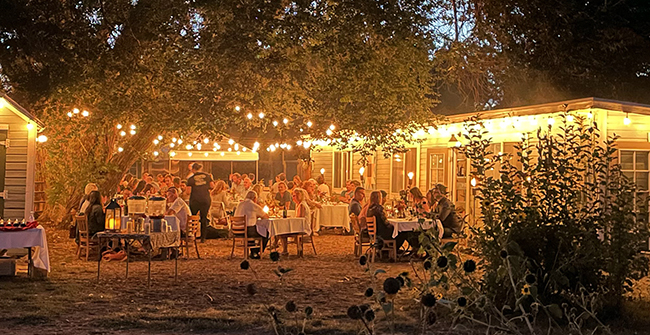
It’s a philosophy that extends well beyond the plate. When the foundation is strong, there’s less need to overwork everything else. From there, the focus naturally shifts to the setting—the physical space that holds the experience. It follows the same logic—simple, open, and responsive to its surroundings. Long tables in the open air. The slow shift of light as the sun drops behind the mountains.
“What really makes it is the setting,” Sara says. “People settle in, have a glass of something cold, and stay a while.”
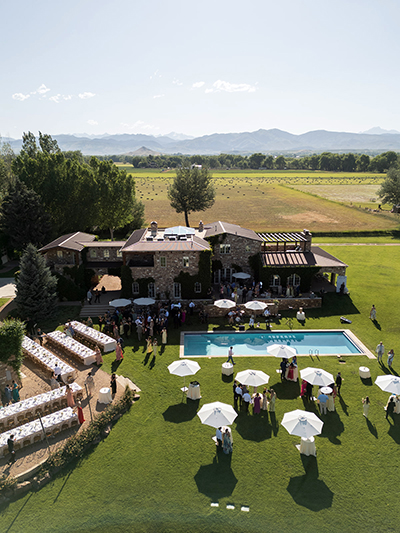
That idea—creating a space people want to linger in—has become the goal. Not a perfectly styled table at the start, but an atmosphere that deepens as the evening goes on. The approach is showing up in more layered, lived-in environments that blur the line between indoors and out. Within that setting, the details of design—florals, lighting, and tabletop elements—start to take shape, not as decoration, but as an extension of the environment itself.
For Heather Dwight, founder of Calluna Events, the shift is about creating spaces that feel like a natural extension of the home rather than a departure from it. Summer gatherings lean into texture and tone over formality, with neutral palettes grounded by a few expressive colors pulled directly from the landscape. Florals are looser, more organic—arrangements that look as though they belong where they’ve been placed, rather than sitting on top of the table as decoration.
Lighting, too, plays an increasingly important role. As fire restrictions make candles less practical, hosts are turning to softer, more controlled sources—cordless lamps, lanterns, and subtle string lighting that carry the evening from golden hour into night without disrupting the mood. But even with the setting and design in place, the way the evening unfolds matters just as much. The effect is less about drama and more about continuity, a gentle transition that keeps people settled exactly where they are.
At the same time, the structure of entertaining itself is loosening. Dinner is no longer the main event—it’s just one part of a longer, more fluid experience.
“People want spaces that feel good, food that feels one-of-a-kind, and connection that’s actually real,” says Shayna Papke, principal event planner and owner of Cherry Bomb Events. “In Boulder, it’s less ‘let’s have dinner’ and more ‘let’s do a thing, then eat.’”
That “thing” might be a hike, a bike ride, or simply time spent outside before gathering around the table. It reflects a broader wellness mindset that runs through our local culture, where movement and connection come first, and everything else builds from there. By the time guests sit down to eat, the evening already has momentum—and the meal becomes a continuation, not a starting point.
Design choices are following that same shift. The overall look is still unmistakably BoCo—relaxed, natural—but it’s evolving in subtle ways. There’s more layering, more intention, and a clear move toward low-impact entertaining. Thrifted pieces, collected glassware, and an absence of anything single-use create settings that feel personal rather than produced. Even the table itself becomes part of that larger story—less styled for appearance, more built around the food and the people gathering around it.
The most effective details, though, are often the smallest. A handful of herbs clipped from the garden and scattered across the table. A branch or wild grasses worked into an arrangement. Handwritten menus or place settings that feel considered without feeling precious. These aren’t showpiece moments—they’re the elements that quietly anchor the experience.
Taken together, they point to a shift away from entertaining as performance and toward something more grounded, more intuitive. In a place where the landscape already does so much of the work, the role of the host is less about adding and more about editing.
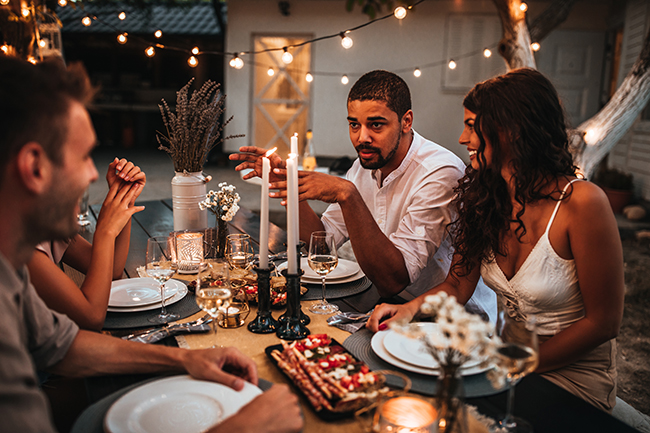
“Pick one thing and do it well,” Shayna says. “Focus on a single focal point and let everything else support it.” Whether that focus is the meal, the setting, or the atmosphere surrounding it, the principle holds. Here, that restraint isn’t a limitation—it’s the point. When the setting, the season, and the company are already doing the heavy lifting, the most thoughtful move is knowing when to step back.
For inspiration and help pulling off your best next event, visit threeleaffarm.com, callunaevents.com, and cherrybombweddings.com.